LOCATION FILE
Tasiilaq — the tupilaq
FOLLOWTasiilaq, Sermersooq
DIRECTIONS →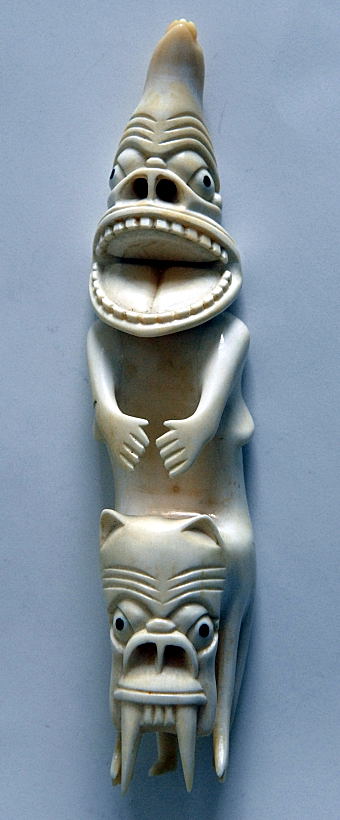
OVERVIEW
Tasiilaq is the largest town in East Greenland, on Ammassalik Island in the Sermersooq municipality, and the centre of a district that was among the last in Greenland to be contacted from outside. It is the place most closely associated with tupilak carving, which is both an art and the surviving trace of a practice.
HISTORY
In Inuit religion, especially in Greenland, a tupilaq was an avenging monster made by an angakkuq — a shaman — out of various objects: animal bone, skin, hair and sinew, and parts taken from the corpses of children. It was given life by ritual chant and put into the sea to seek out and destroy one particular person. The making was done at night and in secret, in an isolated place; the angakkuq wore the anorak backwards with the hood over the face, and the process could take days. The danger ran both ways: if the intended victim had greater power the tupilaq could be turned back on its maker, and the only escape was public confession.
REPORTED ACTIVITY
Because tupilait were made in secret, in hidden places and out of perishable material, not one has ever been preserved. What exists instead are the carvings. Early European visitors, fascinated and unable to be shown the thing itself, asked what a tupilaq looked like — and Greenlandic Inuit began carving representations of them, at first from sperm-whale teeth and now from tooth, bone, antler and soapstone. The entry records a practice that is documented in the ethnography, an object that survives only as an answer to an outsider's question, and a living carving tradition in the town where it is strongest.
VISITING
Tasiilaq is reached by helicopter from Kulusuk. Tupilak carvings are made and sold in the town and shown in the local museum. Note that carvings in marine ivory and bone are subject to export and CITES controls — ask before buying.
SITE PLAN
UPLOAD A PLANNo plan on file yet.
A plan of the building or grounds is what a second team opens on a phone in the dark. Going there? Volunteer to map it, then upload your plan.
EXTERNAL RESOURCES
INVESTIGATION RECORD
0 GROUPS · 0 VISITS
No group has logged an investigation here yet.
HISTORICAL RECORD · 0 CITED ENTRIES
SIGN IN TO CONTRIBUTENo cited entries yet. Deeds, newspaper reports, census lines, photographs, ledgers — anything with a source.
COMMUNITY EVIDENCE
SIGN IN TO VIEWEvidence filed at this location — photos, recordings, documents, notes — is visible to signed-in investigators.
GROUP FINDINGS